Showing posts with label women. Show all posts

9/20/2010

Bullsh*t Feminism

Just for the record, I'm a big fan of bullshit.  In fact, I buy huge bags of it every spring to use in my garden.  Sure it's stinky, but it gets the job done.

Recently, the Feminist Hulk (a tongue-in-cheek twitterer) sent out a tweet about bullshit and it was widely "re-tweeted" (or copied, with attribution) by many users in The Exponent community.* It read:


When I first saw this tweet I bristled a bit at the profanity.  These words carry more weight and are somewhat more offensive when in print than when heard in casual conversation.  However, that's precisely why I liked the tweet.  I felt uncomfortable and it caught my attention.  And that discomfort made me think about how feminism is portrayed on The Exponent blog.   The look of our blog is organic and feminine: pastel colors, the leaf motif, subdued fonts.  The photos in the sidebar are artful--all of winsome smiling young women.  Not a scary old hairy feminist in the bunch.  I'd say that we sit squarely on the "softer side" of the feminist line when compared to mainstream feminist blogs like Feministing, Bust, or Pandagon.

So when the bullshit post from above was re-tweeted on the official Exponent channel, several of the bloggers protested on the private permablogger listserv.  And when the week's aggregate feed post went up, the bullshit tweet was removed because it was considered too vulgar for an Exponent post.

I'm shaking my head here, as I ponder whether feminism is best served with a wink and a smile.  Our sisters who fought for the 19th amendment weren't afraid of a little discomfort.  I'm not necessarily suggesting that profanity be used in every Exponent post--just the opposite.  When used judiciously, the discomfort that results from a smartly-used swear word can serve to illustrate an important point.  Because if the Hulk tweet had said simply "RESIST THE PRESSURE TO DOWNPLAY FEMINISM TO MAKE PEOPLE MORE COMFORTABLE.  DISCOMFORT CAN BE PRODUCTIVE," I seriously doubt it would have had even half the intended impact. Discomfort can be productive.  But when we carefully sanitize our writing so we don't push boundaries or let things get a bit ugly, are we missing out?

In fact, not one reader even mentioned the Hulk tweet or the profanity in the twitter blogpost.  If someone had been offended, I'm sure they would have let us know--the fact that the profanity passed unnoticed by our readers makes me wonder if there was even any cause for concern in the first place. 

When I use steer manure in my garden I have to be cautious to ensure that it's been properly aged or it can burn young seedling plants.  Similarly I can see why profanity needs to be used with caution, because of the possibility of "burning" those blogreaders who are only just barely acquainted with feminism or who might be turned-off by a bit of bullshit.  But at the same time I can't help but wonder if the discomfort is really our own, and not that of our imagined audience--and if it is, then what are we really afraid of?

*Note: For new readers of my blog: I'm a founding member of The Exponent blog, which focuses on Mormon feminism and other topics that are relevant to progressive LDS women.

8/20/2010

Follow along with #genderd on Sept 1st

About ten years ago began to think deeply about the ways I was gender-typing my children. Though I've always been a fairly open-minded parent, I could see that my gentle teasing to my son about his interactions with the cute girls in his class, or my suggestion to my daughter that she style her hair a particular way were based on the gender stereotypes that I didn't necessarily agree with ideologically. And while I saw that my academic language was evolving to me more gender-neutral, sometimes I had to work hard to be more inclusive with gender-based ideas in my parenting and other daily interactions. This wasn't because I held gendered expectations about my children per se, it was more due to the pervasive way in which it was unknowingly embedded my behavior and speech.

When I recently went through the SafeSpace training for Chapman University, we participated in an exercise that caused us to reflect on the many ways our society creates and reinforces sex-based binaries. Since then I've made note of each time I've been forced to declare my gender and wondered how awkward it might feel if my gender assignment at birth and my gender expression were different. I've marveled at how frequently those Male/Female questions are asked on forms for travel, medical care, employee benefits, and financial records. When possible, I've stopped declaring my sex, but I rarely see this as an allowed option (and I hate that word "other" on sex-based questions--how dehumanizing that seems).

Because I think so much of the way we experience gendered expectations on a daily basis is subtle--so subtle we don't even notice it--I am going to try an experiment in a few weeks and hope you'll join in. On September 1st, I'm going to tweet every moment in my day that I experience a gendered interaction. Whether it's the choice of a restroom to use, an interaction where I'm callled "ma'am," a time when I'm forced to make a choice on a form that asks for F or M, or any other moment where I feel that gender plays a role in my day. If you're willing, I'd like for you to join me in this exercise, and also participate in reflecting on the experience either here in the comments of this post or on your own blog. For easy searching I'll be marking my tweets with the hashtag #genderd (shorthand for "Gender Day"), and will collect all the tweets into a twapperkeeper for archival purposes.

5/10/2009

Pilgrim classic: Mother's Day Proclamation for Peace

Originally posted May 13, 2007:

The celebration of Mother's Day originated with poet Julia Ward Howe, as a movement for women to fight the devastation of war and to show the way towards peace. Today's sentimental-flowers-&-Hallmark-card bedecked event hardly measures up to the fiery rhetoric of the day's founding mother...

Julia Ward Howe's Mother's Day Proclamation - 1870

Arise then...women of this day!
Arise, all women who have hearts!
Whether your baptism be of water or of tears!
Say firmly:
"We will not have questions answered by irrelevant agencies,
Our husbands will not come to us, reeking with carnage,
For caresses and applause.
Our sons shall not be taken from us to unlearn
All that we have been able to teach them of charity, mercy and patience.
We, the women of one country,
Will be too tender of those of another country
To allow our sons to be trained to injure theirs."

From the bosom of a devastated Earth a voice goes up with
Our own. It says: "Disarm! Disarm!
The sword of murder is not the balance of justice."
Blood does not wipe out dishonor,
Nor violence indicate possession.
As men have often forsaken the plough and the anvil
At the summons of war,
Let women now leave all that may be left of home
For a great and earnest day of counsel.
Let them meet first, as women, to bewail and commemorate the dead.
Let them solemnly take counsel with each other as to the means
Whereby the great human family can live in peace...
Each bearing after his own time the sacred impress, not of Caesar,
But of God -
In the name of womanhood and humanity, I earnestly ask
That a general congress of women without limit of nationality,
May be appointed and held at someplace deemed most convenient
And the earliest period consistent with its objects,
To promote the alliance of the different nationalities,
The amicable settlement of international questions,
The great and general interests of peace.

10/29/2008

voting

On Monday when I voted, I was ebullient. I Love Voting. Just love it. Although it probably sounds really corny to say this, I felt the spirit of folks like Martin and Alice and Harvey right there alongside me there in that uber hi-tech voting booth. I was also surrounded by dozens of undergrads who were exercising their right for the very first time. The thrill was palpable.

People who are voting next Tuesday: bring a lawnchair and some leftover Halloween candy to share. Those lines are going to be long, but don't let that deter you. Just do it.

:)

9/06/2008

gettin' political


I do not believe that women are better than men. We have not wrecked railroads, nor corrupted legislatures, nor done many unholy things that men have done; but then we must remember that we have not had the chance.

--Jane Addams, in a speech to the Chicago Political Equality League in 1897

This quote from Jane Addams seems particularly salient given recent events (h/t Penny L. Richards). I'm thrilled to see more diversity in our highest political offices and it's also quite exciting that Americans are seeming to really care about politics.

May I suggest some ways that you Californians might want to exercise a bit of your political influence? First of all, grab your cellphone. It's time to call the Governor.

1) Harvey Milk Day: This bill would require the Governor to annually proclaim May 22 as Harvey Milk Day, and would encourage public schools and educational institutions to conduct suitable commemorative exercises on that date.
To show your support for this bill, calll 916-445-2841
If you reach a staff member, tell them that you are support AB 2567 Harvey Milk Day.
Or if you get a recording...follow the recorded instructions to voice your opinion.

Some biographical details about Harvey Milk:
Perhaps more than any other modern figure, Harvey Milk's life and political career embody the rise of the lesbian, gay, bisexual, and transgender (LGBT) civil rights movement. Milk was born on May 22, 1930. He was the first openly gay person to be elected to public office in a major city, serving on the San Francisco Board of Supervisors from 1977-1978.
While in office, Milk worked to pass a gay rights ordinance and defeat Proposition 6, commonly known as the Briggs Initiative, which would have banned gays and lesbians from teaching in public schools. Milk encouraged LGBT people to be visible in society and believed coming out was the only way they could achieve true social equality.
Milk was tragically assassinated in 1978 by Dan White, a former colleague on the Board of Supervisors whose politics often clashed with Milk’s. After resigning from the Board and being denied reappointment by then Mayor George Moscone, White entered San Francisco City Hall through a window armed with a gun and shot and killed both Moscone and Milk.
During White’s criminal trial, the defense argued that White was a victim of pressure and had been depressed, a state exacerbated by his consuming a large quantity of junk food before the murders. This later became known as the "Twinkie Defense." When this tactic proved successful and White was convicted of voluntary manslaughter and a mere seven years and eight months in prison, San Francisco's gay community erupted into protest in what came to be known as the "White Night Riots."
Harvey Milk's legacy as a civil rights leader is still felt today. He was named one of TIME Magazine's most influential people of the 20th century. Many institutions and organizations are named for Harvey Milk to commemorate his life and social contributions.

2) Universal HealthCare: SB 840.
To weigh in on this bill, call 916.445.2841.
Some info about this Universal HealthCare bill:
General approach. Senate Bill 840 would establish a single-payer health insurance system for California. A new government-administered system would replace all private health insurers and existing government insurance programs, including Medicare. An elected Health Insurance Commissioner would oversee all aspects of the new system, including contracts with health care providers, the allocation of health care workforce and capital equipment, and the introduction of new technologies.

Eligibility and benefits. All residents of California—defined as those with a physical presence in the state with intent to reside—would automatically be covered under the system. The benefit package would be very comprehensive, including not only the usual range of inpatient and outpatient services, diagnostic and laboratory services, and prescription drugs, but also mental health services, dental and vision care, chiropractic services, adult day care, and 100 days of skilled nursing care following hospitalization. Long-term care would not be covered. Copayments and deductibles could be established for other than preventive care. Patients could choose to receive services from any willing provider and providers would determine what services are medically necessary. Each person would have a primary care physician responsible for approving care to be received from specialists. People could choose to enroll with an integrated health care system, which would be responsible for all their care.

5/10/2008

pilgrimclassic: Mother's Day Proclamation for Peace

Originally posted May 13, 2007:

The celebration of Mother's Day originated with poet Julia Ward Howe, as a movement for women to fight the devastation of war and to show the way towards peace. Today's sentimental-flowers-&-Hallmark-card bedecked event hardly measures up to the fiery rhetoric of the day's founding mother...

Julia Ward Howe's Mother's Day Proclamation - 1870

Arise then...women of this day!
Arise, all women who have hearts!
Whether your baptism be of water or of tears!
Say firmly:
"We will not have questions answered by irrelevant agencies,
Our husbands will not come to us, reeking with carnage,
For caresses and applause.
Our sons shall not be taken from us to unlearn
All that we have been able to teach them of charity, mercy and patience.
We, the women of one country,
Will be too tender of those of another country
To allow our sons to be trained to injure theirs."

From the bosom of a devastated Earth a voice goes up with
Our own. It says: "Disarm! Disarm!
The sword of murder is not the balance of justice."
Blood does not wipe out dishonor,
Nor violence indicate possession.
As men have often forsaken the plough and the anvil
At the summons of war,
Let women now leave all that may be left of home
For a great and earnest day of counsel.
Let them meet first, as women, to bewail and commemorate the dead.
Let them solemnly take counsel with each other as to the means
Whereby the great human family can live in peace...
Each bearing after his own time the sacred impress, not of Caesar,
But of God -
In the name of womanhood and humanity, I earnestly ask
That a general congress of women without limit of nationality,
May be appointed and held at someplace deemed most convenient
And the earliest period consistent with its objects,
To promote the alliance of the different nationalities,
The amicable settlement of international questions,
The great and general interests of peace.

4/13/2008

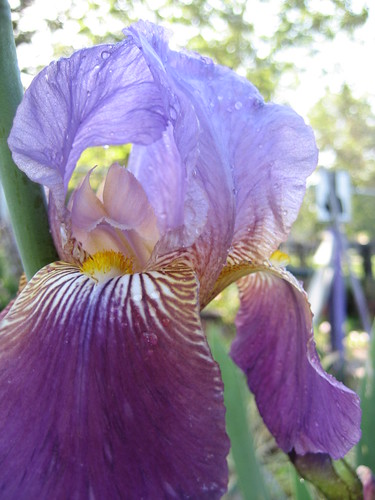
reverence


iris, originally uploaded by pilgrimgirl.

Reverence the highest, have patience with the lowest. Let this day's performance of the meanest duty be thy religion. Are the stars too distant? Pick up the pebble that lies at thy feet, and from it learn the all.
~Margaret Fuller


[Note: this iris is one of the beauties blooming in my garden right now. I love the two-toned purples. Nearly everyone who passes by comments on how spectacular these flowers look.]

2/06/2008

getting political

I didn't vote for her, but this thrilled me anyways...

"I want to thank all my friends and family, particularly my mother, who was born before women could vote, and is watching her daughter on this stage tonight."

-- Presidential candidate Hillary Clinton, Super Tuesday night
H/T to Salon's Broadsheet

You know what else thrilled me yesterday? Knowing that my friend Caroline was standing out in the cold (the requisite 100 ft from the polls) gathering signatures for a petition that means a lot to her. I love it when women get political! :)

2/05/2008

votin'

I'll be teaching this morning then running an errand and heading for the polls. Having been a pollworker for several years I know that the slowest time tends to be around 10-11 in the morning. Lunch is awful and the crowds keep rolling in all afternoon and swell again in the evening.

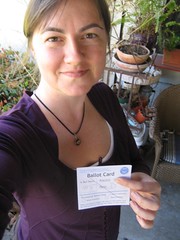
Yes, I know I could use an absentee ballot. But do you know that I would truly miss the THRILL of standing there in the cardboard booth myself? My foremothers, like Quaker Alice Paul, fought so hard to give me this right. And I appreciate it so very much.

UPDATE: a pic of me, post-vote...
exercising my rights...

1/31/2008

Making History with Laurel Thatcher Ulrich


The first half of my recent interview with Laurel is now posted for your listening pleasure. Her reading of selections from Well-Behaved Women Seldom Make History is a joy (I just love hearing authors read their own words). She also discusses the challenge of writing a synthetic book of women's history.

Subscribe to Making History Podcast

12/02/2007

pilgrim classic: because of all that armpit hair

This is one of my most-googled posts ever. Lots of folks out there in cyberspace searching for hairy armpitted feminists, I suppose. Originally posted on March 8, 2007.

In celebration of International Women's Day, Take a minute to watch this short video "Are YOU a Feminist?"

For whatever reason, feminism seems to be equated with armpit hair and lesbianism. That's so odd to me, as I don't know any female feminists that eschew shaving (tho a few male feminists that I know don't shave their armpits) and only a handful of my feminist friends are lesbians. Why is the feminist label so maligned? Is this a legacy of the Equal Rights Amendment era? Or is this indicative of larger social discomfort with assertive women?

An anecdote: I've recently found myself in a social situation where I've observed several undergrads who have behaved belligerently towards an older woman in a position of authority over them. These same students treat a young-ish man with a similar position with much greater respect. Though there are many reasons why this might be happening in this particular situation, I suspect that much of it has to do with gender. Most people seem to be uncomfortable with assertive women, but not so with assertive men. IMO, this is a shame. Though the woman might be more qualified and more capable, the man is preferred. Why?

And, also in celebration of IWD and some truly radical feminist women (no hairy armpits, I promise). Take a few moments to watch and listen:


Note: The original clip that I linked to seems to no longer be available. Here's a similar vid, though with a more contemplative (less militant) bent:

10/31/2007

not so girlish anymore?

Yesterday I was telling someone the URL for my blog and all of a sudden I felt sheepish. Pilgrim_girl_? What am I thinking? I'll be 40 in a few years, for crying out loud! Is it time to let go of the girl and become something else? Something more mature and scholarly-sounding?

BTW, I think pilgrimwoman sounds dorky. Waaaaay too puritannical. I could just be pilgrim, but that's a bit vanilla-ish. Your ideas?

10/08/2007

Motherhood, housework, and who irons the clothes?

There's been a furor in the Mormon blogworld about the leader of Mormon women, President Beck, and her speech this weekend about Motherhood. She said such things as:
"Mothers who know" are nurturers. This is their special assignment and role in the plan of happiness. To nurture means to cultivate, care for, and make grow. Therefore, mothers who know create a climate for spiritual and temporal growth in their homes. Another word for nurturing is homemaking. Homemaking includes cooking, washing clothes, and dishes and keeping an orderly home. Home is where women have the most power and influence. Therefore, Latter-day Saint women should be the best homemakers in the world.

She adds: I have visited sacrament meetings in some of the poorest places on the earth, where mothers have dressed with great care in their Sunday best, despite walking for miles on dusty streets and using worn out public transportation. They bring daughters in clean and ironed dresses. Their sons where white shirts and ties and have missionary haircuts. [Cultural note: missionary haircuts are short 'dos for men where the hair is above the ears and above their shirt collar. There is a cultural norm for boys/men to wear white shirts each Sunday for church and for girls/women to wear their best dresses. Mormon mothers who don't enforce such dress rules for their children are sometimes maligned by church leaders...]

Wow, this was hard for many women to hear. To equate mothering with housekeeping seems an antiquated notion anyways. I'm also sad to hear her say that women's power and influence is limited to a domestic sphere. And to call on LDS women to be the best homemakers in the world seems a shallow goal in the midst of so many ways that LDS women could make an impact on the world.

She said later in her speech:
"Mothers who know" do less. They permit less of what will not bear good fruit eternally. They allow less media in their homes, less distraction, less activity that draws their children away from their home. Mothers who know are willing to live on less and consume less of the world’s goods in order to spend more time with their children, more time eating together, more time working together, more time reading together, more time laughing, talking, singing, and exemplifying.

On this, I am on the same page with her in many respects. I think it is important for _everyone_ to carefully guard against too much busy-ness. It pains me that so many of us are too busy for relaxation, eating meals together, or for an evening stroll. Simplicity is an important goal, and perhaps our biggest challenge as 21st century Americans--especially those of us who live in urban and suburban regions of the country.

As I read through Pres Beck's talk I thought back on my own mother. She gave birth to 5 children in a seven year span of time. About midway through her childbearing years, our family moved out of state--hundreds of miles away from all extended family members--and she had to care for her own growing family while my Dad traveled extensively with his job, sometimes he was gone three weeks/month. She had a large home to care for (4 or 5 bedrooms) and we moved every 5 years or so. Mom was called to lead the regional LDS women's organization that covered parts of three states--meaning that she was frequently on the road traveling to distant church branches and leading meetings. During all that time she kept her teaching credential active in each state where we lived, often taking night classes or taking re-certification exams. By the time her youngest child was in the upper-grades of elementary school, she worked full-time as a teacher and was earning her master's degree.

My Mom was an awesome mother in so many ways. Yes, she was busy. Yes, her health suffered at times from stress-related ailments. But she raised a great crew of kids. Um, and she wasn't always the best homemaker. I don't mean that as any kind of slight AT ALL. The house was rarely 'messy.' She had hearty meals on the table every night of the week. We had clean clothes to wear (sometimes even home-sewn clothes, because Mom is a great seamstress). But she hired a housecleaner to help fill in the gap. And later a gardener and a pool-cleaner, too. She taught us to do our own laundry as soon as we were in Jr High. We also made our own lunches and after school snacks and occasionally cooked dinner for the family.

And probably the most important part of this story is that when my Dad died after a rather aggressive bout with cancer, Mom had a good job (two of them, actually, because she was a school administrator by day and a college professor by night at that point). She had taught us all great life skills, too--we can each sew, clean, cook, budget, etc. Though all of us kids are creative types of people that sometimes find writing a story more important than scrubbing the bathtub, I think we all turned out well (we've all been gainfully employed, three of us have graduate degrees, etc).

I guess the upshot is, if Mom had stayed home and had only been a remarkable homemaker, well I don't know that things would've turned out quite so well for her or for us. Of course everyone's situation is different, which is why I'm dismayed to see a one-size-fits-all approach to motherhood that's portrayed by Pres. Beck. IMO, parenthood has so little to do with how clean your house is and _everything_ to do with how you nurture, care, and respect for the children in your life, as well as making sure that you do all you can to teach them self-reliance and to provide for them financially.

10/03/2007

what are we teaching our daughters?

This vid is making the rounds of the blogworld right now, but if you haven't seen it already, do take a moment.

9/19/2007

my sisters


Several of my sisters from the Exponent II Blog.
From L-R: me, Caroline, Deborah, Dora. Brooke is in front.

Photo by Brooke

7/15/2007

waiting for...


At the WACK exhibit there was a video showing of Faith reading this poem. She rocked back and forth as she recited each line. It was incredibly moving.

As she read I realized that I have waited for almost all of these things and some I am still waiting for. Do you think this 'waiting' is simply part of the human condition or is it an experience that is peculiar to women? What, if anything, do you feel that you are "waiting for"?

Waiting
A Poem by Faith Wilding


Waiting . . . waiting . . . waiting . . .
Waiting for someone to come in
Waiting for someone to hold me
Waiting for someone to feed me
Waiting for someone to change my diaper
Waiting . . .

Waiting to scrawl, to walk, waiting to talk
Waiting to be cuddled
Waiting for someone to take me outside
Waiting for someone to play with me
Waiting for someone to take me outside
Waiting for someone to read to me, dress me, tie my shoes
Waiting for Mommy to brush my hair
Waiting for her to curl my hair
Waiting to wear my frilly dress
Waiting to be a pretty girl
Waiting to grow up
Waiting . . .


Waiting for my breasts to develop
Waiting to wear a bra
Waiting to menstruate
Waiting to read forbidden books
Waiting to stop being clumsy
Waiting to have a good figure
Waiting for my first date
Waiting to have a boyfriend
Waiting to go to a party, to be asked to dance, to dance close
Waiting to be beautiful
Waiting for the secret
Waiting for life to begin
Waiting . . .

Waiting to be somebody
Waiting to wear makeup
Waiting for my pimples to go away
Waiting to wear lipstick, to wear high heels and stockings
Waiting to get dressed up, to shave my legs
Waiting to be pretty
Waiting . . .

Waiting for him to notice me, to call me
Waiting for him to ask me out
Waiting for him to pay attention to me
Waiting for him to fall in love with me
Waiting for him to kiss me, touch me, touch my breasts
Waiting for him to pass my house
Waiting for him to tell me I’m beautiful
Waiting for him to ask me to go steady
Waiting to neck, to make out, waiting to go all the way
Waiting to smoke, to drink, to stay out late
Waiting to be a woman
Waiting . . .

Waiting for my great love
Waiting for the perfect man
Waiting for Mr. Right
Waiting . . .

Waiting to get married
Waiting for my wedding day
Waiting for my wedding night
Waiting for sex
Waiting for him to make the first move
Waiting for him to excite me
Waiting for him to give me pleasure
Waiting for him to give me an orgasm
Waiting . . .

Waiting for him to come home, to fill my time
Waiting . . .

Waiting for my baby to come
Waiting for my belly to swell
Waiting for my breasts to fill with milk
Waiting to feel my baby move
Waiting for my legs to stop swelling
Waiting for the first contractions
Waiting for the contractions to end
Waiting for the head to emerge
Waiting for the first scream, the afterbirth
Waiting to hold my baby
Waiting for my baby to suck my milk
Waiting for my baby to stop crying
Waiting for my baby to sleep through the night
Waiting for my breasts to dry up
Waiting to get my figure back, for the stretch marks to go away
Waiting for some time to myself
Waiting to be beautiful again
Waiting for my child to go to school
Waiting for life to begin again
Waiting . . .

Waiting for my children to come home from school
Waiting for them to grow up, to leave home
Waiting to be myself
Waiting for excitement
Waiting for him to tell me something interesting, to ask me how I feel
Waiting for him to stop being crabby, reach for my hand, kiss me good morning
Waiting for fulfillment
Waiting for the children to marry
Waiting for something to happen
Waiting . . .

Waiting to lose weight
Waiting for the first gray hair
Waiting for menopause
Waiting to grow wise
Waiting . . .

Waiting for my body to break down, to get ugly
Waiting for my flesh to sag
Waiting for my breasts to shrivel up
Waiting for a visit from my children, for letters
Waiting for my friends to die
Waiting for my husband to die
Waiting . . .

Waiting to get sick
Waiting for things to get better
Waiting for winter to end
Waiting for the mirror to tell me that I’m old
Waiting for a good bowel movement
Waiting for the pain to go away
Waiting for the struggle to end
Waiting for release
Waiting for morning
Waiting for the end of the day
Waiting for sleep
Waiting . . .

“Waiting” was performed at Womanhouse in Los Angeles sponsored by the Feminist Art Program, California Institute of the Arts.

7/14/2007

friends


dora-chan, originally uploaded by pilgrimgirl.

Went to the WACK feminist art exhibit this afternoon with friends, including four of the X2 bloggers and some AROOM participants. So fun! As we toured the exhibit that showcased feminist art from the 1970s and 80s I couldn't help but think of our collective sisterhood that's grown out of our affinity for the work started by the feminist foremothers of Exponent II in the 80s. The early X2'ers, like the WACK women, had a growing consciousness of oppression based on sex and gender. They organized themselves and produced books and a newspaper. They wrote poetry, fiction, and personal essays, created art, and aimed to change the world.

An important legacy that we now carry on as Exponent bloggers and blogreaders.

And while I recognize the significance of this legacy, I'm also just thrilled to have this bright and beautiful bunch of women to call my friends. :)

So at the exhibit there were numerous provocative pieces of art. Many challenged gender stereotypes or highlighted the social violence directed towards women. My favorite art piece was a small closet-sized room where all of the walls were painted black. Suspended from the ceiling and from each of the walls was an irregularly woven web of white crocheted yarn. I stood in that room for quite awhile alone. Feeling the warmth and security of being wrapped in a cocoon. But also feeling the connectedness of each of the fibers that composed the web that surrounded me. That experience was, for me, symbolic of the relationships that I have with the world. Yes, there are many patterns and textures to my ties to the people around me--as there were in this particular art installation--but it's the variety and strength of those relationships that make my life so meaningful, that give my days their joy and purpose.

6/30/2007

Who’s Gonna Teach Us to Tango?: A Discussion of Claudia Bushman's MormonStories Interview


Mormon Stories # 058: Women and the LDS Church Part 4 — 19th and Early 20th Century Mormon Women

Mormon Stories # 059: Women and the LDS Church Part 5 — 19th and Early 20th Century Mormon Women Part 2

Claudia Bushman shares more of her insights in this two-part series detailing the lives and experiences of Mormon women in the 19th and early 20th century. Dr. Bushman speaks of ten women who have taken the time to record their life experiences, and as she paraphrases and quotes from each woman’s story, Claudia adds contextual details to show why these stories are all significant. Here’s a list of the featured women:

Part I

1) Lucy Mack Smith, whose story gives great insight into the early life of the church and of the prophet Joseph Smith. Lucy, Joseph’s mother, mixes significant historical happenings with the mundane and comical experiences of daily life. Claudia notes that those who want to read Lucy’s words should seek out a copy of Lavina Fielding Anderson’s most recent edition, Lucy's Book, as previous editions were often heavily edited to purge out some elements of the story (she adds that the editing was sometimes done in such a way that it vilified Emma, Joseph’s first wife, and Lucy because they chose not to travel West with the Saints).
2) Emma Smith’s blessing just after Joseph went to Carthage Jail, which can be found reprinted in Mormon Enigma. Claudia explains that when Joseph was leaving for Carthage, Emma asked for a blessing at his hand. He suggested that she write out her own blessing and he would sign it when he returned home. Joseph was killed by a mob while in the Jail, so the blessing was never signed. But it does offer great insight into the feelings of Emma towards her husband.
3) Charlotte Hafen, a Gentile wrote in 1843 about attending a party at Sidney Rigdon’s house in Nauvoo. We discover that this 9-hour long party included the tying of 5 quilts, an extensive meal, singing songs, and an original dance that started with marching and ended with kissing(!).
4) Mary Isabella Horne writing about the challenges of living in the Salt Lake Valley during the early years—living in a sod house and having to carry an umbrella indoors because of the mud coming down from the ceiling.
5) Ellis Reynolds Shipp: plural wife, mother of several children, and medical doctor. She went to medical school in the East despite a lack of enthusiasm about this career path from her husband. Ellis became pregnant while home for the summer after her first year in med school and returned to school anyways, giving birth just after her exams. Claudia speaks about the many Mormon career women in the Utah period, adding that there were more women doctors in the Utah region than anywhere else in the US.

Part II

6) Elizabeth Caine (wife of a friend of the Mormons, Thomas Caine), writes as she travels by wagon from Salt Lake to St George and describes the homes that she visits along the way. She found polygamy repulsive, especially when she saw on older man “going down the generations to his grandchildren’s time to seek a new partner…while she who shared the joys and sorrows of his youth looks on, old and grey.”
7) Claudia’s grandmother, Elizabeth Shupe Gordon (1866-1896) gives an inspiring account of her conversion to the church, speaking of burning “electric thrills” that she felt each time she read from the Book of Mormon.
8) Alice Louise Reynolds: Prof of English & Religion at BYU. She was such a friend to everyone that a group of women decided to organize an Alice Louise Reynolds Club, and there were 15 chapters of this club in the 50s. Never married, she spent her sabbaticals teaching at other universities and traveling. Amy Brown Lyman became her biographer, bio was published by ALR Clubs.
9) The Newberry-award winning author Virginia Sorensen.[Note: she mentions Sorensen elsewhere in the podcast and doesn’t discuss her much at this point]. Those who want to learn more about Mormon life in the early 20th century would enjoy reading Where Nothing is Long Ago, a collection of short stories by Sorensen.
10) Historian Juanita Brooks was this very powerful intellectual who lived a fairly traditional life. Claudia retells a humorous incident from Juanita’s childhood and then discusses her work as a historian: she would always kept the ironing board up and had a basket of dampened clothes near her desk and when someone came by she’d start ironing so they’d never know that she was really writing [note: this reminds me of the stories I’ve read of Jane Austen hiding her writing under her needlework]. Brooks would travel on overnight buses to do research in Salt Lake or at the Huntington Library.

The discussion ends with interviewer John Dehlin asking Claudia some general questions about women and religion. Some interesting points in this section occur when Claudia decries those that leave the church. She says,
“Leaving the church is not any kind of an answer to a better life. That’s just like leaving something good for outer darkness. It’s just better to stick with the church and try and make something out of it.”
Yet she also discusses how much the church has changed since she was younger, explaining that her grandchildren have told her that they’ve “never had a happy experience at church.” Claudia says that her childhood and teen years in the church were joyful and happy and that the “block” scheduling has destroyed much of the fun. “Who’s gonna teach us to tango now?” she asks as she reminisces about the tango dancing lesson she had annually in her ward.

Claudia encourages women to make their own way in the church, organizing projects and special interest groups. She says that those who are miserable in the church should write about their disaffection, leaving their thoughts for future generations. As she says at the beginning of Part I:
“It’s the people who write, who last. If any woman out there has any inclination to to remembered in the future, the next few generations, she’d just better get busy and write out her story, her experiences.”

Some questions for those of you who listen to the podcast:

1) Which the women she profiled were new to you? Which of their writings/stories did you find most compelling?

2) How do you express your feelings about the church? Do you write them down? Do you expect or hope that someday someone (a Mormon historian, perhaps) will be using your words to tell about the condition of women in the church in the 21st century? Do you see blogs as an accurate recording of the lives of contemporary LDS women?

3) If you could organize a special project or interest group in your ward, what would it be? Would you want to learn to tango? :)

Note: the photo above is of Alice Louise Reynolds.

6/24/2007

non, je ne regrette rien

If "La Vie en Rose" is playing in a theater near you, I highly recommend that you watch it. It's well-crafted, well-acted, and quite moving. A biopic about French singer Edith Piaf, it's not hagiographic. She was certainly human: selfish, addicted to drugs and alcohol, etc. But she also experienced enormous tragedy: her only child dying, several traumatic relationships, a childhood spent in her grandmother's brothel, singing on the streets to earn money for food & booze. Though the film doesn't touch on her resistance work during WWII, that's also an important element of her fame and fiery spirit.

The film is non-chronological, which works well in this case as it contrasts her youthful disappointments, her meteoric rise to fame, and then her physical decline from chronic & terminal disease in her late 40s. For me, the overarching theme of the film was for Piaf to actually 'live' her music rather than just belting out pretty songs. By the end, when she is onstage in what will be a final heroic rendition of her song "Non, Je ne Regrette Rien", you can see that she really owns the song. It is pure Edith Piaf, with all of her flaws, singing of the richness of her life. Here's a quick youtube vid of her performing the song following these translated lyrics...

Translated from the French
No! No regrets
No! I will have no regrets
All the things
That went wrong
For at last I have learned to be strong

No! No regrets
No! I will have no regrets
For the grief doesn't last
It is gone
I've forgotten the past

And the memories I had
I no longer desire
Both the good and the bad
I have flung in a fire
And I feel in my heart
That the seed has been sown
It is something quite new
It's like nothing I've known

No! No regrets
No! I will have no regrets
All the things that went wrong
For at last I have learned to be strong

No! No regrets
No! I will have no regrets
For the seed that is new
It's the love that is growing for you

5/30/2007

women in art

This video about 500 years of women in art is gorgeous. You won't regret watching it. Now I just wish there was a similar vid about 500 years of female artists.