2/27/2010

on passion, evangelism and madness

riding to the getty

Yesterday I led another workshop about some of my favorite web-based research tools. My colleagues like to tease me about how zealous I am about such things--my enthusiasm causing me to talk very quickly, show too many glitzy features, and gush. I suspect that my evangelism is charming rather than off-putting (at least, I hope so). I try not to say that using Zotero or GoogleSuite will change the world as we know it, but sometimes I sort of think it will.

Of late, I've come to realize that I need to believe in what I'm doing to be enthusiastic about it. For example, my loss of faith the UC has made it increasingly hard to be tied to that ship, despite all the good that's come of my years at UCI. And while I've spearheaded some small efforts for change at UC, I no longer feel that our high-level administrators have the interests of the humanities at heart (departmental admins, OTOH, rock), so I'm looking forward to moving on. A similar thing happened with the LDS church. I was a super-champion of Mormonism until the foundation gave way (for me), and then it became impossible--even repulsive--to carry on with the organization. I'm not halfway person. Either I love it and believe in it, or I lose interest.

Having such passion serves me well in many circumstances. When I'm in the front of the classroom I am teaching, believing, and professing with everything I've got. Parenting absorbs me completely. My friends know of my wholehearted love affair with my two perfect children (and the amazing man that I made them with)--there is no ambivalence there. Whether I am gardening or traveling or swimming, it is done with body and soul. And there is a thrill with being able to live so fully, so committed. If I say or do something, it's because I believe in it.

Life itself seems lunatic. Who knows where madness lies? Perhaps being too practical is madness. To surrender to dreams, this may be madness. To seek treasure where there is only trash is madder still. Too much sanity may be madness. But maddest of all, to see life as it is and not as it should be."
(adapted from Dale Wasserman's screenplay, "The Man of La Mancha")

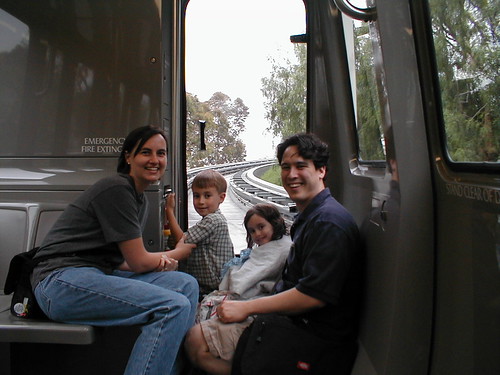
Photo above is of us riding the tram up to the Getty museum when GameBoy was about 6 and CatGirl was 3-ish years old. We love taking our kidlings to museums! I'd forgotten that John and I had matchy-matchy black Dickies messenger bags back then. So cute!

2/25/2010

living a life different enough to be worth writing about


china 2005, originally uploaded by pilgrimgirl.

I've been attempting to articulate a particular feeling for several days now, and here Jeffrey Tayler has done it so well.

If you had 99 lives, what would you do with them? With the one life you have, what will you do that will be different and exciting, worthy of recounting in print? If you’re short on ideas, as I was, let the protagonists of novels and short stories show you how to live; let the great writers, with their imagined plots and characters, introduce you to new paths in real life. I don’t necessarily mean milquetoast paths, easy ways out. So, if you’ve read “A Bend in the River,” let Salim the Indian trader, who came up from the coast to open a shop on the Congo River, show you what you can do when you have nowhere else to go. Let Georges Duroy, the pitiless hero of Maupassant’s “Bel-Ami,” show you what you can do if you arrive penniless in Paris. “The Sheltering Sky” might serve as your guide to Morocco, Jack Kerouac’s “On the Road” to the U.S. The point is that great writers and their works can provide blueprints for changes in our lives. They can teach us about how many possible ways ahead there are, both good and bad. And bad is not as bad as all that. Remember, for a writer, adversity makes good subject material.

The protagonist of “The Death of Ivan Il’ich” died moaning, in agony, overcome with the realization that he had wasted his days on earth following social conventions. He lacked l’esprit frondeur, and he paid for it. Conventions now are hardly less pervasive than they were in Tolstoy’s day; we’re pressured to start a career, build our résumé, earn a certain amount of money, and so forth. But remember: None of us gets out of here alive. So don’t fear risks. Rebel. Be bold, try hard, and embrace adversity; let both success and failure provide you with unique material for your writing, let them give you a life different enough to be worth writing about.


Picture from my trip to China a few years ago--a charming round "hobbit door" that I discovered in a garden. What a wonderful adventure that was!

2/24/2010

orange

In the last few days I've been smelling blossoms on breezes--magnolia blossoms, mostly, but also just a hint of citrus. It's a little early yet for orange blossoms, but my anticipation is building, nonetheless.

So this morning I read a thin book of poetry called The Orangery by Gilbert Sorrentino. Each poem in the volume is about orange or oranges. Just what I needed today. It's full of delicious ironies about the impossibilities of orange (and it doesn't rhyme, of course).
An excerpt from "Variations 1"

Poetry must not be poured into molds
the man said, fighting an old battle
filled with wild alarums.

No one eats oranges
in anybody's poems


The image above is from a jaunt to Brooklyn in winter where outside an art gallery there was a bare tree hung with oranges. It delighted me--I am a fan of the ridiculous and unexpected.

2/16/2010

Busy-ness

clover
Friends:

This week and next I will be unusually busy. I look forward to catching up with you when I return. I will be full of adventures to share--including some details of a trip to the East Coast! :)

If you are in New Haven or Boston and you want to meetup this weekend, please drop me a line. It will be a whirlwind trip, but I hope to find time for friends!

2/08/2010

Bridges

Cross posted at History Compass

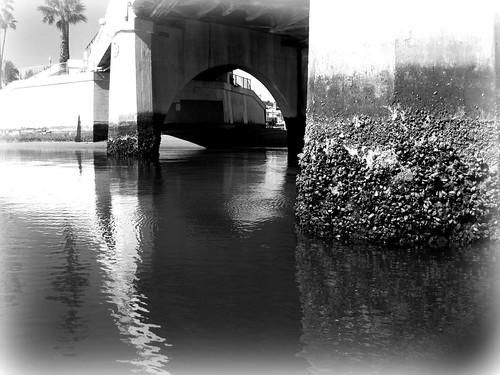
Lido bridge at low tide
Since I started paddling an outrigger canoe through the Newport harbor, I've gone under a lot of bridges. I learned, very quickly, that the current around bridges can be unpredictable--even dangerously so. In my small boat if I hit a bridge it means that I'll likely end up going for an unintentional swim and the blow from hitting a cement pylon can easily cause irreparable damage to my fragile canoe.

As I paddled under a low-lying bridge last week and heard the uncanny echo of water and wind through that space, I realized why trolls always live under bridges in folktales. Bridges are important places--necessary crossroads. But they are also liminal places where danger lurks. It might be in the form of a malintentioned someone hiding in the shadows, or it might be a whirl of current that pulls the boat toward a cement piling encrusted with mussel shells. Whatever the possibilities, bridge-crossings demand heightened attention.

Like the dangers of the bridges that I face as I paddle around segments of the harbor, there seem to be trolls lurking around the bridges of academia, too.

2/05/2010

Morbidly romantic


035:365 Braided Bones., originally uploaded by mind on fire.

A gift to my lover, upon celebrating 20 years of togetherness (he wrote the poem for me 8 years ago).

I just wish that I'd thought to black out one of these legs from mid-femur on down. :)

2/04/2010

Dear LDS missionaries

clementine oranges

This letter is prompted by two recent visits from LDS missionaries. One was two nights ago, when I was knocked out on drugs and could barely register what was happening in the living room. Apparently the elders came by "just to visit" people on the ward list. John politely explained that he's not a member of the church and said that our family has officially requested "no contact" with the church. He asked the elders to pass that information on to the powers-that-be in the ward, given that our earlier request was not honored. The letter below is from the previous of the two visits...

Dear LDS missionaries who helped me carry my groceries in the rain:

First of all, it was very nice of you to help me--particularly with that box of clementine oranges that I was grasping awkwardly with two fingers while having 3 or 4 bag handles draped over each arm. It was obvious I was about to lose some oranges, so the help was very considerate.

I liked how genuinely surprised you seemed when I greeted you each as "Elder" and asked where you came from. That you were both from rural Utah didn't surprise me very much--you both looked pretty intimidated by the heathen graduate students milling around our neighborhood. When you found out that I was nearly done with my PhD, one of you asked for suggestions for a good college major. My reply that a degree in engineering might be a good way to support a family was sincere--I worry about young LDS couples and their ability to survive in today's economy. That you both looked at each other and admitted that neither of you can do math reminded me just how very young you missionaries are, and I realized how hard it must have been for your mothers to let you go for two years.

It probably seemed like the reason that I didn't invite you in after you helped with the groceries was because I was busy. But it really was because I didn't want the conversation: the one where I would explain about apostasy, about not going to church for awhile. And about institutions and inequity and history. About needing a new place to call home. About wounds. About the kinds of life experiences that couldn't be articulated to two nineteen year-old boys who don't even know what to study in school.

I wanted your memory of the afternoon to be one of rescuing a fellow Saint who was about to lose her oranges. Not of a lost soul for you to pity.

And when I prayed, as you walked away in the rain, that you would avoid the doors of my neighbors who have been the most hurt by the Church's influence...that was one of my most sincere prayers in quite some time.

Love,
Jana

2/03/2010

the phantoms


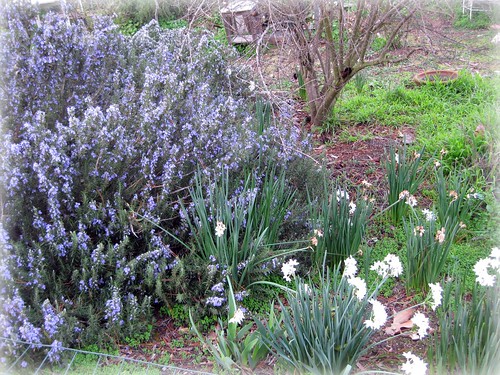
Alice's garden, originally uploaded by pilgrimgirl.

Let me just say first that I'm not writing this because I'm seeking sympathy, or pity. It's just one facet of life as an amputee, and since one of my primary aims of blogging here is to discuss the experiences of my different body, that's why I'm writing this post.

A few times a year, I get the phantoms. I've mentioned them occasionally on my blog before. There's not much of a pattern to when they happen, except that I've noticed they are more likely to occur when I'm dehydrated or sick. They were pretty bad when I was pregnant, too.

Generally, I don't think being an amputee is all that painful. As long as I've got a prosthesis that fits well, my pain level is probably not all that different from anyone else who's heading towards middle-age. Of course, when my leg isn't fitting well or when I've got pressure sores or rashes on my stump, that's a bit of a different story. But I'm lucky not to be experiencing any of those problems right now.

The past few days we've had a cold/flu bug going around our family. Yesterday I pressed on with my regular schedule despite feeling pretty cruddy. And then it hit me right around dinner time--the nerves in my right leg started spasming. The pain level is pretty close to what I felt when I had labor contractions before my babies were born. It starts in my leg and causes my entire body to shake for a few seconds. To be fairly descriptive of how it was feeling yesterday, it was as if someone had poked a metal wire up along the side of my femur bone and then ran a jolt of electricity through that wire every few minutes. Oddly, the pains are different each time it happens. It used to feel more like my toes were being twisted off one-by-one. Or that someone was ironing the bottom of my non-existent foot.

There are a few remedies that work--walking helps, as does some pressure on my stump or a warm shower. But really the only thing I've found that truly helps is a dose of a strong muscle relaxant. So that's what I took last night, and then slipped into sleep, only waking occasionally to note that the spasms were becoming weaker as the night wore on. When I awoke this morning I felt stiff and sore in my right hip, with just a very faint metallic-tingly feeling. As if my leg had "fallen asleep" and was just waking up.

I don't know how other amputees experience phantom pains. Those I know, I've never thought to ask. It's not something that I think about very often, or that impacts my life in any huge way. It just happens sometimes. And I don't think I'm particularly heroic for having endured phantom pains--we all have these little tricks that our bodies play on us once in awhile. Whether it's lower back pain, that stiff elbow, or the arthritis that gets to us when it rains. I figure we're all just doing the best we can and some days that means we have to take it easy for awhile.

2/01/2010

Mary Monday: poetry in motion

Spotted this crane heron while paddling on Saturday and was lucky enough to capture him just taking off (most likely my fault--my boat is nearly 20 ft long and the strong current was carrying me a wee bit close when I snapped this).